Skip to content
How to Choose a Home Remodeling Contractor in MetroWest MA
Most homeowners spend more time researching a new appliance than they do vetting the contractor who’ll spend three months inside their home. That’s how projects go sideways — not because remodeling is inherently unpredictable, but because the wrong contractor makes it that way.
In 2024, 78% of homeowners exceeded their renovation budget, and 29% fired a contractor before the job was done (Clever Real Estate, Home Renovation Trends, 2024). Those aren’t outliers. They’re what happens when homeowners skip the vetting process and pick based on price alone.
This guide walks through every step — licensing, insurance, references, contracts, and the one guarantee almost no MetroWest contractor will offer you. Whether you’re planning a kitchen remodel in Newton, a bathroom renovation in Lexington, or a basement finishing project in Acton, the process is the same. Get it right before you sign anything.
Key Takeaways
• In 2024, 78% of homeowners went over budget on renovations and 29% fired a contractor mid-project — both are avoidable with proper vetting (Clever Real Estate, 2024).
• Every Massachusetts contractor doing work over $1,000 must hold a Home Improvement Contractor (HIC) registration — verifiable for free on mass.gov.
• A written contract, milestone-based payment schedule, and at least three checked references are non-negotiable before any project starts.
• A contractor-issued money-back guarantee is the highest protection available — and fewer than 1% of contractors in MetroWest offer one.
Why Do So Many MetroWest Remodels Go Over Budget?
In 2024, a Clever Real Estate survey of 1,000 homeowners found that 78% exceeded their renovation budget — and 44% went over by at least $5,000 (Clever Real Estate, Home Renovation Trends, October 2024). Budget overruns are the most visible problem, but they’re rarely the only one. The same survey found that 29% of homeowners fired a contractor mid-project, 32% had contractors fail to show up, and 39% believed their contractor cut corners.
That’s a majority of homeowners, on some dimension, experiencing a serious problem.
Here’s what makes this hard: a licensed contractor isn’t automatically a good contractor. Licensing is the floor, not the ceiling. A contractor can hold every required credential in Massachusetts and still miss deadlines, miscommunicate costs, or disappear when something goes wrong. The vetting process described in this guide goes beyond credentials — it’s about finding someone you can trust with your home and your money.
Why does this matter even more in MetroWest? Because projects here aren’t small. According to the Sweeten Boston Home Renovation Cost Guide (updated November 2025), kitchen remodels in the Boston and MetroWest area range from $35,000 to $100,000 or more. Basement renovations average around $88,000. At those numbers, a bad hire doesn’t just cause stress — it causes real financial damage.
From Fabio, owner of Grand Finish Remodeling: “The most common call I get isn’t from someone asking for a quote. It’s from a homeowner who hired the lowest bidder six weeks ago and is now three months behind schedule with a half-finished kitchen. In over ten years of remodeling homes in Framingham, Wayland, and Newton, the pattern is almost always the same — they skipped the vetting steps. This guide covers every step I’d want my own family to take before signing with any contractor, including us.”

Source: Clever Real Estate, Home Renovation Trends, October 2024
The FTC received 81,925 reports of home improvement scams in 2024 alone (FTC Consumer Sentinel Network Data Book, March 2025). Most of them were preventable. The steps below tell you exactly how.
Step 1: Verify Massachusetts Contractor Licensing Before Anything Else
In Massachusetts, any contractor doing home improvement work valued at $1,000 or more must hold a Home Improvement Contractor (HIC) registration through the state’s Office of Consumer Affairs and Business Regulation (OCABR). Contractors who work without registration face fines up to $5,000 and up to two years in prison under M.G.L. Chapter 142A (HBRAWM Consumer Guide, citing MA state statute).
You can verify any contractor’s HIC registration for free at mass.gov/ocabr. It takes about 90 seconds. Do it before the first meeting.
HIC vs. Construction Supervisor License (CSL) — know the difference.
An HIC registration covers general home improvement work. A Construction Supervisor License (CSL) is a separate, higher credential required when the work involves structural elements — load-bearing walls, additions, foundation work, or anything that changes the structure of the building. If your project involves structural changes (common in basement finishing, additions, or major kitchen remodels that open walls), your contractor needs both.
Ask every candidate: “Can you give me your HIC registration number and CSL number?” Any legitimate contractor will produce these immediately. Hesitation or a promise to “send it later” is a problem.
Massachusetts law requires every home improvement contractor to maintain an active HIC registration for projects over $1,000. If a judgment is later entered against a registered contractor and they don’t pay, homeowners can claim up to $25,000 from the Massachusetts Guaranty Fund — but only if the contractor was registered. An unregistered contractor removes that protection entirely (Mass.gov OCABR).
When choosing a bathroom remodeling contractor or any other specialist, this verification step applies equally — licensing is not trade-specific.
License Lookup: Verify any contractor’s Massachusetts HIC registration at mass.gov/ocabr. It’s free, takes under two minutes, and tells you whether a contractor’s registration is active or expired.
Step 2: What Insurance Does Your Contractor Actually Need to Carry?
The median home renovation spend reached $24,000 in 2023 — a 60% increase from $15,000 in 2020 — and 51% of renovating homeowners spent $25,000 or more (2024 U.S. Houzz & Home Study, Houzz 2024). At those amounts, uninsured work on your property isn’t just careless — it’s a serious financial exposure.
Every remodeling contractor you consider should carry two separate policies:
General Liability Insurance covers property damage and third-party injuries. If a contractor’s crew damages your floors, cracks a wall in an adjacent room, or causes water damage during a bathroom remodel, general liability pays for it. Look for a minimum of $1 million in coverage per occurrence.
Workers’ Compensation Insurance covers injuries to the contractor’s employees and subcontractors while working on your property. Without it, an injured worker can file a claim against your homeowner’s insurance — or sue you directly. This isn’t hypothetical. It happens.
Don’t just ask whether a contractor has insurance. Ask for a Certificate of Insurance (COI) and call the insurer listed on the certificate to confirm the policy is current. Policies can lapse. A certificate from last year doesn’t mean coverage exists today.
Without separate General Liability and Workers’ Compensation policies, a Massachusetts homeowner can be held personally liable for injuries sustained on their own property during renovation work. The median renovation project now costs $24,000 (Houzz 2024 U.S. Houzz & Home Study) — an amount that makes uninsured work a meaningful financial risk for any homeowner.
Grand Finish Remodeling carries both policies on every project. We provide a Certificate of Insurance at the start of every engagement, and we’ll never ask you to take that on faith.

Step 3: How to Vet References and Past Work (the Real Way)
In 2024, 59% of homeowners found their contractor through word of mouth or personal referrals, and 38% used websites and social media (2024 U.S. Houzz & Home Study, Houzz 2024). Referrals are still the gold standard — but only if you ask the right questions.
Most homeowners ask a reference: “Were you happy with the work?” That’s too vague. A homeowner who was happy with the result might still have dealt with two missed deadlines and a final invoice 15% over the estimate. Happiness isn’t the same as a smooth project.
Ask these questions instead:
- Did the project finish within the original timeline?
- Did the final cost land within the original estimate?
- How did they handle unexpected problems when they came up?
- Would you hire them again for a larger project?
- Would you give them an unsolicited referral to a neighbor?
That last question is the real signal. Most people will say “yes” to avoid an awkward conversation. But “would you proactively recommend them to someone you care about?” gets you closer to the truth.
Beyond direct references, check Google, Houzz, and Angi. Look at the volume of reviews, not just the rating. A contractor with 72 five-star reviews has earned something a contractor with 8 five-star reviews hasn’t — consistency across dozens of different projects and clients.
Referrals from family and friends remain the #1 method homeowners use to find remodeling contractors, used by 59% of homeowners in 2024 (2024 U.S. Houzz & Home Study, Houzz). But the quality of the reference conversation matters more than the referral itself. Asking specific questions about budget adherence and timeline accuracy reveals far more than a general satisfaction rating.
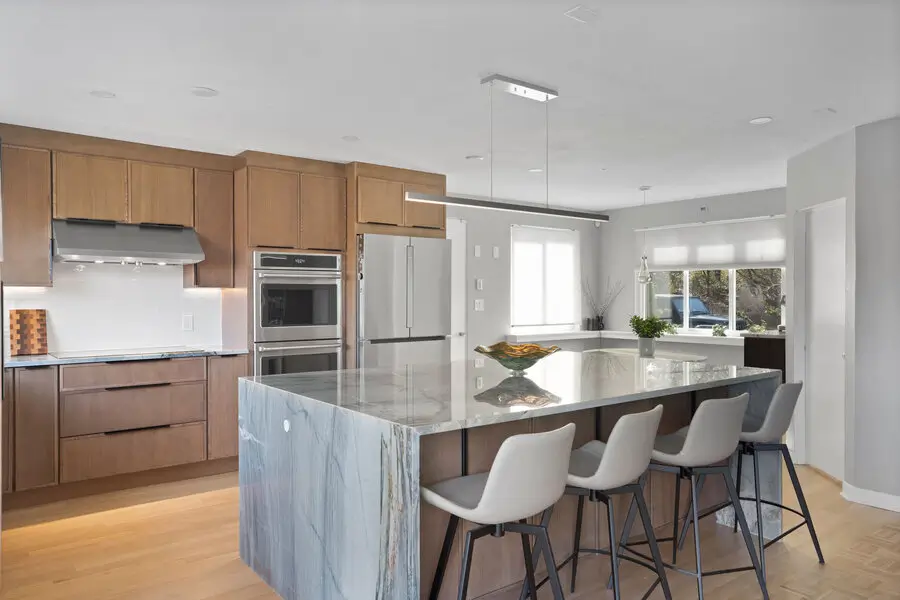
You can see real before-and-after kitchen results from Grand Finish projects — not just polished photos, but the actual scope of what changed and why it matters.(SVG file: assets/chart-how-find-contractors.svg)

Source: 2024 U.S. Houzz & Home Study, Houzz, 2024
Step 4: What Must a Massachusetts Remodeling Contract Include?
Under Massachusetts law (M.G.L. Chapter 142A), any home improvement contract over $1,000 must be in writing and signed by both parties before work begins (Mass.gov Homeowner’s Guide). A verbal agreement isn’t enforceable. If a contractor resists putting the details in writing, that’s your answer.
A compliant Massachusetts remodeling contract must include:
- Start and projected completion dates — not approximate months, specific dates
- A full materials list — brand, model, grade, and quantity for major items
- A detailed payment schedule — tied to milestones, not calendar dates
- Who is responsible for pulling permits — it should always be the contractor
- A dispute resolution process — what happens if there’s a disagreement
- The contractor’s HIC registration number — required by law on the face of the contract
Massachusetts law: Contractors may not demand or accept a deposit of more than one-third of the total contract price before work begins (M.G.L. Chapter 142A). If a contractor asks for 50% or more upfront, walk away.
The safest payment structure ties installments to project milestones: roughly 10% upfront, 25% when framing or demo is complete, 25% at rough-in stage, 25% when finishes are installed, and 15% at final walkthrough and punch list completion. This structure keeps both parties accountable at every stage of the project.
Massachusetts General Law Chapter 142A mandates written contracts for all home improvement projects over $1,000, with deposits capped at one-third of the total contract price. A payment schedule tied to project milestones — rather than calendar dates — is the safest structure for homeowners. If a written contract isn’t presented before work begins, the homeowner’s legal protections under state law are significantly reduced (Mass.gov, M.G.L. Chapter 142A).
For context on what a full renovation project entails, the bathroom remodeling steps guide walks through the complete process stage by stage — useful reference when reviewing a proposed project timeline.

Step 5: What Guarantee Should a Great Contractor Offer?
In 2024, more than 90% of renovating homeowners hired professional help for their projects (2024 U.S. Houzz & Home Study, Houzz 2024). Every single one of those homeowners faced the same question: what happens if something goes wrong?
Most people assume the answer is the Massachusetts Home Improvement Contractor Guaranty Fund. Here’s what the Guaranty Fund actually is: a state-administered program that compensates homeowners up to $25,000 for unpaid court judgments against registered HIC contractors (Mass.gov OCABR). It’s a safety net — but it’s a reactive one. To access it, you need to win a court judgment first. That means a dispute, an attorney, a filing, and months or years of process. For most homeowners, that’s not a real solution.
A contractor-issued money-back guarantee is something different entirely. It’s a proactive commitment — made before work begins — that if the project doesn’t meet agreed standards, you get your money back. You don’t file a claim. You don’t hire an attorney. The contractor stands behind the work or makes it right.
Almost no remodeling contractor in MetroWest offers this. It’s rare because it requires the contractor to be genuinely confident in their work, their team, and their process. It also requires financial stability — you can’t offer a money-back guarantee if you’re operating project to project.
The Massachusetts Home Improvement Contractor Guaranty Fund provides up to $25,000 in compensation for homeowners who win a court judgment against a registered contractor — but access requires litigation, not just a complaint (Mass.gov OCABR). A proactive money-back guarantee from the contractor itself is a fundamentally different form of protection: it’s a pre-litigation commitment to stand behind the work, and it’s offered by fewer than 1% of MetroWest remodeling contractors.
Grand Finish Remodeling offers a money-back guarantee on every project we take on. Not as a marketing line — as a policy. If the work doesn’t meet the standards we agreed to, we make it right. That commitment is part of every contract we sign.
Step 6: What Red Flags Should Make You Walk Away?
The FTC logged 81,925 home improvement scam reports in 2024 (FTC Consumer Sentinel Network Data Book, March 2025). The vast majority of those situations shared common warning signs — signs that were visible before the contract was signed.
In 2024, the FTC received 81,925 reports of home improvement scams — making it one of the most complained-about consumer categories in the country (FTC Consumer Sentinel Network Data Book, March 2025). Most of these situations involved unlicensed contractors, no written contracts, or large upfront deposits. Basic pre-hire vetting eliminates exposure to the majority of these scenarios.
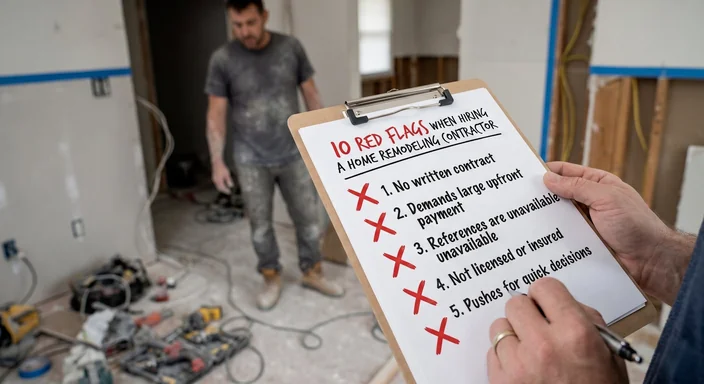
Know what to watch for. Each of these is a reason to stop the process:
1. They can’t produce a license number on the spot.
Any registered HIC contractor knows their registration number. If they need to “look it up later,” verify it yourself — or move on.
2. They ask for more than one-third of the project cost upfront.
This is illegal under Massachusetts law. It’s also a classic warning sign that the contractor is using your deposit to fund another project.
3. They pressure you to sign quickly.
“I have another job starting next week, so I need a decision by tomorrow.” Legitimate contractors don’t manufacture urgency. A good contractor has a pipeline, not desperation.
4. No written contract is offered.
A contractor who resists putting scope, timeline, and costs in writing isn’t someone you want inside your home.
5. They suggest pulling permits in your name.
Permits should always be pulled by the contractor. When they’re in your name, you absorb the liability for the work.
6. Their bid is dramatically lower than the others.
Two bids come in around $45,000. One comes in at $27,000. That gap isn’t efficiency — it’s a scope discrepancy, unlicensed labor, or a plan to request change orders throughout the project. Low bids rarely stay low.
7. No physical business address and no local references.
A contractor working in Waltham, Natick, or Sudbury should have completed local projects with verifiable references. “I’m new to the area” isn’t reassuring when someone is about to spend $50,000 inside your home.
8. No insurance documentation provided.
Already covered above — but worth repeating as a red flag. Any hesitation to provide a Certificate of Insurance is a problem.
For more on planning your MetroWest remodel — including how to set a realistic budget before you start collecting bids — the Framingham homeowner planning guide covers this in detail.
Step 7: Questions to Ask Before You Sign
Good vetting isn’t just verification — it’s conversation. The way a contractor answers your questions tells you as much as the answers themselves.
These questions to ask before hiring apply whether you’re hiring a kitchen remodeler, a bathroom contractor, or someone to finish your basement. The core questions don’t change:
- “Who specifically will be on-site each day — your employees or subcontractors?” Subcontractors aren’t inherently a problem, but you should know who’s entering your home and whether they’re licensed.
- “Can you walk me through how you handle unexpected costs?” The answer should describe a written change order process, not a verbal agreement.
- “What’s your current project load, and who manages this project day-to-day if you’re on another job site?” Owner-operators who are personally available are different from companies where you rarely see the decision-maker after the contract is signed.
- “Have you done projects of this size and type in this town before?” Local experience matters. Permit requirements differ between Newton and Framingham. A contractor who knows the Wayland building department isn’t starting from scratch.
- “Do you offer any form of satisfaction or money-back guarantee?” Most won’t. The ones who do are telling you something meaningful about how they run their business.
The MetroWest Homeowner’s Complete 10-Point Vetting Checklist
Use this checklist before signing with any contractor in Wayland, Newton, Lexington, Sudbury, Dover, Framingham, Acton, Holden, Natick, Waltham, or Sterling. Every item should be completed before any money changes hands.
Grand Finish track record: In over a decade of remodeling MetroWest homes, the vast majority of our projects finish on time and within 5% of the original quoted price. That’s not an accident — it’s the result of detailed scoping, milestone-based contracts, and the kind of accountability that comes with backing your work with a guarantee.

Grand Finish Remodeling — MetroWest MA’s only full-service remodeler with a money-back guarantee
Grand Finish Remodeling meets every item on this list on every project. If you’re comparing typical kitchen remodel costs in MetroWest or budgeting for basement finishing costs in Massachusetts before reaching out, those resources will help you walk into conversations with realistic numbers.
Schedule your free consultation with Grand Finish →
Frequently Asked Questions
How do I verify a contractor’s license in Massachusetts?
Go to mass.gov/ocabr and search by company name or registration number. Every Massachusetts contractor doing work over $1,000 must hold an active Home Improvement Contractor (HIC) registration. For structural work — additions, load-bearing walls, foundations — also verify a Construction Supervisor License (CSL). Both searches are free and take under two minutes. If a contractor’s registration is expired or absent, don’t hire them.
How much deposit should I pay a home remodeling contractor in Massachusetts?
Under Massachusetts General Law Chapter 142A, contractors cannot legally demand a deposit exceeding one-third of the total contract price before work begins. A milestone-based payment structure is safest: roughly 10% upfront, with subsequent payments tied to verifiable project stages rather than calendar dates. If a contractor requests 50% or more upfront — especially in cash — that’s a red flag, regardless of how confident they seem.
What is the Massachusetts Home Improvement Contractor Guaranty Fund?
The Guaranty Fund is a state program that compensates eligible homeowners up to $25,000 for unpaid court judgments against registered HIC contractors (Mass.gov OCABR). To access it, you must first win a legal judgment against the contractor — which means pursuing a formal dispute process. It provides protection after something goes wrong, not before. A contractor-issued money-back guarantee is the proactive alternative: the contractor commits to making it right before the project starts.
Do any home remodeling contractors offer a money-back guarantee?
Very few do. Most contractors in MetroWest rely on the state Guaranty Fund as the default backstop — which, as explained above, is litigation-dependent. A proactive money-back guarantee means the contractor stands behind the quality of their work without requiring legal action from the homeowner. Grand Finish Remodeling offers a money-back guarantee on all projects. It’s included in the contract, not offered as a verbal assurance. It’s one of the reasons we hold 72+ five-star Google reviews across Wayland, Newton, Lexington, Framingham, Natick, and surrounding MetroWest towns.
What are the biggest red flags when hiring a home remodeling contractor?
The clearest red flags: demanding full payment or more than one-third of the project cost upfront; resisting a written contract; no verifiable HIC registration number; no local references from projects in MetroWest; an unusually low bid compared to other estimates; pressure to sign quickly; and suggesting that permits should be pulled in the homeowner’s name rather than the contractor’s. Any one of these signals a problem. More than one means walk away.
The Right Contractor Makes the Difference
Choosing a home remodeling contractor isn’t just a procurement decision — it’s a trust decision. You’re letting someone into your home for weeks or months, making decisions that will affect how you live in it for years.
The process isn’t complicated. It’s just thorough:
- Verify HIC registration and CSL on mass.gov before any other step
- Confirm two insurance policies — general liability and workers’ comp — with a call to the insurer
- Ask references specific questions about timeline, budget, and whether they’d hire again
- Get everything in writing — contract, materials, payment milestones, permit responsibility
- Look for a money-back guarantee — the highest signal of contractor confidence available
MetroWest homeowners working in Newton, Lexington, Sudbury, Acton, Holden, Dover, Sterling, or anywhere across the region deserve a contractor who delivers on time, within budget, and stands behind the work.
Grand Finish Remodeling is the only MetroWest contractor with a money-back guarantee and 72+ five-star Google reviews. Get a free, no-pressure quote today.
Get your free quote → Try our Cost Estimator → (confirm Cost Estimator URL before publishing)
Sources
- Clever Real Estate, Home Renovation Trends 2024, October 2024, retrieved 2026-05-17, https://listwithclever.com/research/home-renovation-trends/
- FTC Consumer Sentinel Network, Data Book 2024, March 2025, retrieved 2026-05-17, https://www.ftc.gov/system/files/ftc_gov/pdf/csn-annual-data-book-2024.pdf
- Houzz, 2024 U.S. Houzz & Home Study: Renovation Trends, 2024, retrieved 2026-05-17, https://www.houzz.com/magazine/2024-u-s-houzz-and-home-study-renovation-trends-stsetivw-vs~174492310
- Harvard Joint Center for Housing Studies, Modest Gains in the 2025 Outlook for Home Remodeling, January 2025, retrieved 2026-05-17, https://www.jchs.harvard.edu/blog/modest-gains-2025-outlook-home-remodeling
- Massachusetts OCABR, Home Improvement Contractor (HIC) Program, retrieved 2026-05-17, https://www.mass.gov/info-details/home-improvement-contractor-hic-program
- Massachusetts OCABR, Homeowner’s Guide to Hiring a Home Improvement Contractor, retrieved 2026-05-17, https://www.mass.gov/info-details/homeowners-guide-to-hiring-a-home-improvement-contractor
- HBRAWM (Home Builders & Remodelers Assoc. of Western MA), How to Choose a Builder or Remodeler, retrieved 2026-05-17, https://hbrawm.com/consumer-information/how-to-choose-a-builder-remodeler/
- Sweeten, Boston Home Renovation Cost Guide, updated November 2025, retrieved 2026-05-17, https://sweeten.com/blog/home-renovation-cost-guides/boston/