Skip to content
In 2024, the FTC received 81,925 home improvement scam reports, making it one of the most complained-about consumer categories in the country (FTC Consumer Sentinel Network Data Book, March 2025). That number doesn’t capture every case. It captures only the people who knew they’d been scammed and bothered to report it.
Here’s what’s frustrating: the warning signs are almost always visible before you sign anything. They show up in how a contractor handles your first phone call, how they present their bid, and whether they can hand over a license number without hesitating. The problem isn’t that these signs are hidden. It’s that most homeowners don’t know what to look for.
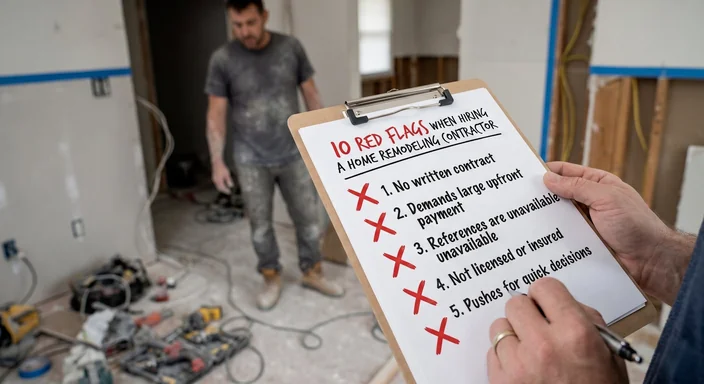
This post walks through all 10. If a contractor you’re considering triggers even two or three of these flags, that’s your answer.
Key Takeaways
- In 2024, the FTC received 81,925 home improvement scam reports — most involved the same handful of warning signs (FTC Consumer Sentinel, 2025).
- Massachusetts law caps contractor deposits at one-third of the total project price. Any demand for 50%+ upfront violates M.G.L. Chapter 142A.
- A contractor who can’t produce a license number, won’t show insurance, or resists a written contract is telling you who they are before work starts.
- Red Flag #10 — no form of guarantee — is the rarest and most meaningful signal of contractor confidence.
Red Flag #1: They Can’t Produce a License Number on the Spot
Every Massachusetts contractor doing work over $1,000 must hold an active Home Improvement Contractor (HIC) registration through OCABR. Legitimate contractors know their number — they print it on every estimate and every contract. If a contractor can’t give it immediately, verify it yourself at mass.gov/ocabr. That’s a 90-second check that could save you everything.
Massachusetts has two separate registrations worth understanding. The HIC covers general renovation work. The Construction Supervisor License (CSL) is required for structural work — load-bearing walls, additions, and foundations. A contractor can hold an HIC without a CSL, which matters if your project touches structure. Ask for both numbers and check both.
Why does this verification matter so much? Because it determines whether you can access the state’s financial backstop if something goes wrong.
The Massachusetts Home Improvement Contractor Guaranty Fund only applies to work performed by registered contractors. In 2022, the Fund collected $800,614 but paid out only $170,615 to harmed homeowners — a gap that exists partly because many hired unregistered contractors and were ineligible to file a claim (Massachusetts OCABR records, via Walls & Ceilings, 2023).
Massachusetts law requires any home improvement contractor working on projects over $1,000 to maintain an active HIC registration. Homeowners who skip this verification lose access to the state Guaranty Fund, the only post-dispute financial protection available under state law. According to Massachusetts OCABR records (via Walls & Ceilings, 2023), the Fund paid out only $170,615 to harmed homeowners in 2022 despite collecting $800,614 in revenue that year.
Verification takes two minutes. There’s no excuse to skip it. For everything else to verify before signing, the complete MetroWest contractor vetting guide covers every credential and contract step in detail.
Red Flag #2: They Ask for More Than One-Third Upfront
Under M.G.L. Chapter 142A, a deposit exceeding one-third of the total contract price is illegal in Massachusetts before work begins. A 50%+ request isn’t aggressive sales — it’s a violation of state law, and a near-certain signal that the contractor needs your money to fund another job before yours even starts.
Large upfront deposits are the single most common mechanism for contractor fraud. The pattern is consistent: contractor collects a substantial deposit, starts work half-heartedly or not at all, becomes unreachable. Cash-only requests make this worse. Cash leaves no paper trail, no dispute pathway, and no leverage if you need to pursue recovery.
The right payment structure ties money to completed milestones. Something like: a deposit at signing (one-third or less), a payment at demolition completion, another at rough-in sign-off, another at finishes installation, and a final payment only after a completed walkthrough with your written approval. Every payment should be tied to something you can physically verify.
From Fabio, owner of Grand Finish Remodeling: “Once a month, I get a call from a homeowner who paid $15,000 or $20,000 to a contractor who then disappeared. Every single time, they paid more than one-third upfront — usually in cash. In ten years of remodeling in Newton, Framingham, and Wayland, this is the most predictable fraud pattern I see.”
Since 2020, the MA Trial Court recorded 939 cases filed under “larceny by false pretense” for home improvement fraud, and fewer than 20% were resolved (NBC Boston investigation citing MA Trial Court data, 2024). The deposit is almost always where those cases begin.
Red Flag #3: They Don’t Carry Insurance — or Hesitate to Prove It

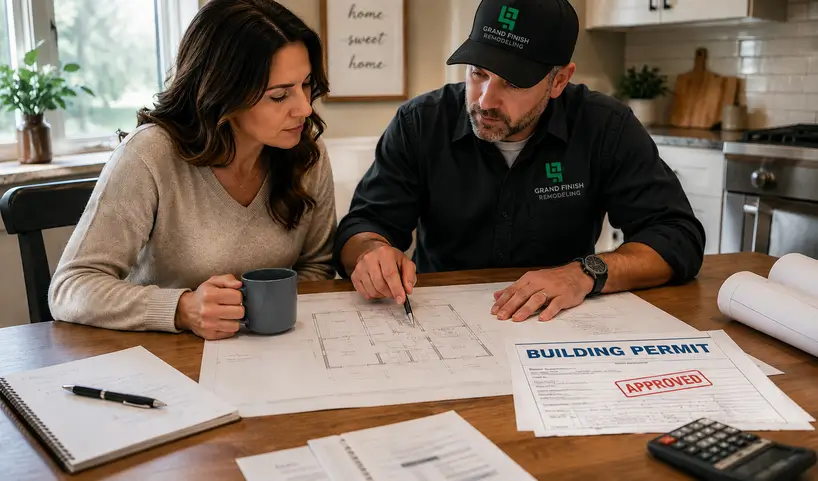
Contractor and homeowner reviewing insurance and contract documents together at a desk
In 2024, the median home renovation spend reached $24,000 — 60% higher than $15,000 in 2020 (Houzz, 2024 U.S. Houzz & Home Study). At that scale, an uninsured contractor isn’t just careless. They transfer real financial liability onto you the moment they set foot on your property.
Two policies are required, and both matter for different reasons. General Liability covers property damage and third-party injuries — if a subcontractor drops something through your floor, this pays for it. Workers’ Compensation covers workers injured on your job site. Without Workers’ Comp, an injured worker can file a claim against your homeowner’s insurance policy, or sue you directly as the property owner.
Asking for a Certificate of Insurance (COI) is the right start — but it’s not enough on its own. A COI from three months ago doesn’t mean the policy is still active. Call the insurer directly, confirm the policy number, and confirm the coverage dates. It takes five minutes and closes a real exposure.
A contractor who hesitates to provide proof of insurance, or who offers to “send it later,” isn’t protecting a business asset. They’re protecting you from finding out the policy lapsed.
Without active General Liability and Workers’ Compensation coverage, a Massachusetts homeowner can be held personally liable for injuries sustained on their property during a renovation. In 2024, the median renovation project cost roughly $24,000 — a 60% increase from 2020 — according to the Houzz 2024 U.S. Houzz & Home Study. At that investment level, uninsured contractor work represents a direct financial threat to the homeowner.
Red Flag #4: They Won’t Put Everything in Writing
Massachusetts law under M.G.L. Chapter 142A requires a written, signed contract for any home improvement project over $1,000. A verbal agreement isn’t enforceable in Massachusetts. Full stop. A contractor who resists writing things down is operating in a way that specifically disadvantages you if anything goes wrong — and that’s not an accident.
The contract must include specific elements under state law: start and completion dates, a detailed materials list, a milestone-based payment schedule, the contractor’s HIC number, and a dispute resolution process. If any of these are missing, the contract may not be enforceable.
Change order fraud is the version of this red flag that costs MetroWest homeowners the most money. A contractor deliberately prices a bid 30% below competitors to win the contract, then submits a series of “required” change orders throughout the project — for unexpected conditions, upgraded materials, or additional scope — that you can’t reasonably refuse once you’re two months into a gut renovation with your kitchen in pieces. Without a detailed written scope and a signed change order process built into the contract from day one, you have no protection against this pattern.
In 2024, 29% of homeowners fired a contractor mid-project (Clever Real Estate, Home Renovation Trends Survey, n=1,000, October 2024). Missing or vague contracts drive a significant share of those terminations. A good contract isn’t bureaucracy. It’s the only document that protects both parties when something goes sideways.
These contract requirements apply regardless of trade. Whether you’re choosing a bathroom remodeling contractor or a kitchen specialist, the legal framework under M.G.L. Chapter 142A is the same.
Red Flag #5: They Suggest Pulling Permits in Your Name
Permits should always be the contractor’s responsibility. When permits are pulled in the homeowner’s name instead, the homeowner assumes full legal and financial liability for all work — including code violations discovered years later, potentially when you’re trying to sell the property. If a contractor suggests this arrangement, ask them directly why.
There are two reasons a contractor pushes this, and neither is good for you. First, they may lack the Construction Supervisor License required for structural work — you can’t pull a structural permit without one, but an owner-builder technically can. Second, they may want to avoid a permit trail entirely, which means the work won’t be inspected, and any defects are yours to deal with.
Owner-builder status in Massachusetts is a real legal category, but it comes with obligations most homeowners aren’t prepared for. You become the responsible party for code compliance. If the work fails inspection at resale, the liability traces back to you, not the contractor who did the work.
The fix is simple: legitimate contractors pull their own permits. It’s how inspections get scheduled, how compliance gets documented, and how you protect your investment long-term.
Red Flag #6: Their Bid Is Dramatically Lower Than the Others

In 2024, 78% of homeowners exceeded their renovation budget, and 44% went over by at least $5,000 (Clever Real Estate, Home Renovation Trends Survey, October 2024). A bid 30-40% below competitors isn’t efficiency. It’s almost always a scope discrepancy, unlicensed labor, or a plan to recoup the margin through change orders once the project is underway.
There are three consistent explanations for a dramatically low bid. First, the contractor excluded scope items your other bidders included — a common tactic that makes the bid incomparable, not competitive. Second, they’re pricing in unlicensed or uninsured labor to cut costs in ways you won’t see until something goes wrong. Third, they’re using the low number to win the job with full intention of recovering the margin through undisclosed change orders.
How do you test this? Ask directly: “Your bid is significantly lower than the others. What specifically explains the difference?” A confident, knowledgeable contractor will walk you through their reasoning — different material specs, a more efficient work sequence, or a genuine scope difference they’ll point to in writing. A contractor with something to hide will deflect, change the subject, or simply repeat that their price is better.
Beyond $10,000, the numbers get harder to ignore. In 2024, 35% of homeowners exceeded their budget by $10,000 or more (Clever Real Estate, 2024). That kind of overrun rarely comes from legitimate surprises. It comes from bids that were never designed to hold.
In 2024, 78% of homeowners exceeded their renovation budget and 44% went over by $5,000 or more, according to the Clever Real Estate Home Renovation Trends Survey (n=1,000, October 2024). Dramatic low bids — often 30-40% below competitors — are rarely sustained through project completion. The gap is typically made up through undisclosed change orders or reflects unlicensed, underinsured labor.
Red Flag #7: They Pressure You to Sign Quickly
“I have another job starting Monday — I need your decision by end of day.” That’s not a scheduling reality. It’s a tactic designed to prevent you from doing the vetting that would reveal a problem. Good contractors don’t manufacture urgency. They have pipelines, and they give you time to make a confident decision.
Why does urgency work on people? It triggers loss aversion. You’ve spent two hours with this contractor, you like them, you’ve mentally started picturing the finished kitchen. The fear of losing that slot feels real. But here’s the thing: any contractor worth hiring has enough work that one more day won’t sink their schedule.
New England adds a seasonal dimension to this pattern. Storm chasers follow significant weather events, appearing in neighborhoods within days of a major event and pressuring homeowners to sign before the week is out. Spring brings the “we’re booking up fast” push, timed to when homeowners are itching to start projects. Post-disaster contractor fraud in the U.S. is estimated at roughly $9.3 billion annually (NICB estimate via Claims Journal, May 2024). That estimate is broad, but the underlying pattern is consistent and well-documented.
The rule is simple. Any contractor who won’t give you 48 hours to verify their license, check references, and review the contract isn’t worth having. A contractor who respects your decision-making process is telling you something important about how they’ll treat you once the project starts.
Red Flag #8: No Local References and No Verifiable Business Address
A contractor working in Newton, Natick, or Framingham should have a real local business address (not a P.O. box), completed local projects, and at least three references you can actually call in the same area. An out-of-area crew with no local accountability is a fundamentally different risk category than a contractor your neighbor has used.
Local experience matters more than people realize. Permit requirements differ between towns — Newton’s building department processes things differently than Framingham’s, and Wayland has its own inspectors and timelines. A contractor who’s never pulled a permit in your town is more likely to miss a local requirement, create an inspection delay, or underestimate the timeline.
How do you verify a business is real? Google Maps the address and see if it’s an actual office or workspace. Check the Massachusetts Secretary of State business registry to confirm the entity is active. Review the BBB profile — not just the rating, but the age of the profile and the complaint history. A brand-new BBB listing with no history can mean a contractor who cycles through entity names to reset their reputation.
The numbers on credential-checking are sobering. In a survey of approximately 1,000 respondents, 1 in 10 Americans reported losing money to a contractor scam, with an average loss of $2,426 — and more than 50% of those victims had checked credentials before hiring (JW Surety Bonds Survey, ConsumerAffairs, 2023). Checking credentials matters, but it only works if you know what to check.
For a full list of questions to ask before signing with any contractor, those questions apply across all remodeling trades — not just kitchen design.
Red Flag #9: Poor Communication Before Work Even Starts

In 2024, 54% of homeowners said they struggled to find qualified professionals, citing delays and limited availability (Angi, 2024 State of Home Spending Report, January 2025). High demand makes it tempting to hire whoever shows up and seems capable. But a contractor who’s vague or slow during the proposal phase will be worse once they have your deposit and are managing three other jobs simultaneously.
Communication patterns don’t improve under pressure. They reveal character. The way a contractor handles your phone calls and emails before they’ve been paid tells you exactly how they’ll handle them when they’re in the middle of your project and something goes sideways.
What does good pre-project communication actually look like? A 24-hour response window on calls and emails, minimum. A line-item estimate that you can actually read and compare. A named person who will be your day-to-day contact once work starts — not a general number that goes to whoever picks up. A clear answer to the question: “Who calls me if there’s a problem on-site?”
That last question is the test. A contractor who can’t answer it hasn’t thought through how they’ll manage your project. A contractor who answers it without hesitation has done this enough times to know that communication structure matters.
Poor pre-project communication is a reliable predictor of project problems. In 2024, 54% of homeowners reported difficulty finding qualified remodeling professionals, according to the Angi 2024 State of Home Spending Report (January 2025). High demand makes it tempting to hire whoever is available — but a contractor who is slow or vague during the proposal phase will be slower and vaguer once they have your deposit.
Red Flag #10: They Offer No Form of Guarantee on Their Work

Grand Finish Remodeling — MetroWest MA’s only full-service remodeler with a money-back guarantee on every project
Most contractors rely on the Massachusetts Home Improvement Contractor Guaranty Fund as their default backstop — but that Fund only pays out after you win a court judgment against the contractor first. In 2022, the Fund collected $800,614 and paid out only $170,615 to harmed homeowners (Massachusetts OCABR records, via Walls & Ceilings, 2023). That’s not a protection. That’s a last resort.
The Guaranty Fund has real limitations worth understanding clearly. It’s reactive, not proactive — you have to already be in a dispute serious enough to litigate before it’s relevant. The maximum payout is $25,000. It applies only to registered HIC contractors. And you need a court judgment before you can even file a claim. Most homeowners who’ve been harmed by a contractor can’t wait out that process.
A contractor-issued money-back guarantee works differently. It’s written into the contract before work starts. It doesn’t require a lawsuit or a court date. It means the contractor has made accountability structural — not a verbal assurance they’ll make it right, but a contractual obligation with teeth.
The absence of a guarantee isn’t just a missing feature. It’s a signal. A contractor who won’t commit to standing behind their work before the project starts is telling you, indirectly, that they’re not certain they can. A contractor who offers a money-back guarantee has made accountability structural. It’s built into the contract itself, which means they’ve thought through what it means if the work doesn’t meet the standard — and they’re prepared to own that outcome.
Why do almost no contractors offer one? Because it requires genuine confidence in the quality of the work and the financial stability to back that commitment up. A contractor operating on thin margins, using substandard materials, or overextending across too many jobs simply can’t afford to offer a guarantee. The contractors who can offer it are, almost by definition, the ones who don’t need to worry about invoking it.
Grand Finish Remodeling offers a money-back guarantee on every project we take on — not as a talking point, but as a policy written into every contract. It’s one of the reasons we hold 72+ five-star Google reviews across Wayland, Newton, Lexington, Natick, Framingham, and surrounding MetroWest towns.
Get your free, no-pressure quote →
What to Do When You Spot a Red Flag
The best outcome is spotting a red flag before you sign anything. Walk away. Document what you observed — the specific ask, the date, the contractor’s name and registration number if you have it. That documentation matters if you later need to file a complaint or warn other homeowners.
If something illegal already occurred — an illegal deposit demand, work performed without a permit, a contractor who disappeared with your money — you have multiple filing options. The Massachusetts OCABR handles complaints against registered HIC contractors and administers the Guaranty Fund process. The Massachusetts Attorney General’s Consumer Protection Division handles broader fraud complaints. The BBB accepts complaints and can flag a contractor’s profile for future homeowners researching them.
Leaving a factual, specific review also matters. Not venting — just the facts: what you were promised, what happened, what the outcome was. That kind of review protects the next homeowner who’s doing exactly what you’re doing right now: trying to figure out who to trust.
For a complete walkthrough of the vetting process from licensing through contract review, the MetroWest contractor hiring guide covers every step.
Frequently Asked Questions
How do I verify a contractor’s license in Massachusetts?
Go to mass.gov/ocabr and search by company name or registration number. Every contractor doing work over $1,000 must hold an active HIC registration. For structural work — load-bearing walls, additions, foundations — also verify a Construction Supervisor License (CSL). Both searches are free, take under two minutes, and tell you whether a registration is active or expired.
Is it illegal for a contractor to ask for more than one-third upfront in Massachusetts?
Yes. Under Massachusetts General Law Chapter 142A, contractors cannot demand or accept a deposit exceeding one-third of the total contract price before work begins. A request for 50% or more upfront is a legal violation — and a reliable signal that the contractor may be using your deposit to fund other jobs rather than yours.
What is the Massachusetts Home Improvement Contractor Guaranty Fund?
It’s a state program that compensates eligible homeowners up to $25,000 for unpaid court judgments against registered HIC contractors (Mass.gov OCABR). But access requires winning a legal case first — it’s a reactive backstop, not proactive protection. In 2022, the Fund collected $800,614 but paid out only $170,615 to harmed homeowners (Walls & Ceilings / OCABR data, 2023).
What do I do if a contractor takes my deposit and disappears?
File complaints immediately with OCABR (mass.gov), the Massachusetts Attorney General’s Consumer Protection Division, and the BBB. If the contractor held an active HIC registration, you may be able to pursue a Guaranty Fund claim after obtaining a court judgment. For losses under $7,000, Massachusetts small claims court is available without an attorney.
Do any home remodeling contractors offer a money-back guarantee?
Almost none in MetroWest. Most contractors rely on the state Guaranty Fund as their default backstop — which requires litigation to access. Grand Finish Remodeling offers a written money-back guarantee on all projects. It’s included in the contract, not offered as a verbal assurance. See our bathroom remodeling contractor guide for more on what to expect from a contractor who stands behind their work.
The Right Contractor Passes Every Check on This List
These 10 red flags are visible before you sign anything. You just need to know what to look for. The good news: most legitimate contractors pass every one of these checks without hesitation. License number? They know it. Insurance? They hand you the COI and tell you to call the insurer. Written contract? They hand you one before you ask.
Here’s the short version of the checklist. Verify the HIC registration at mass.gov/ocabr. Confirm General Liability and Workers’ Comp are active — not just promised. Get everything in writing, including your change order process. Never pay more than one-third upfront. Ask directly about a guarantee.
Grand Finish Remodeling passes every item on this list, on every project, in Wayland, Newton, Lexington, Sudbury, Dover, Framingham, Acton, Holden, Natick, Waltham, and Sterling.
Schedule your free consultation →
If you’re still planning your scope, the full bathroom renovation guide gives a realistic timeline and process overview that applies to most major renovations.
Sources
- FTC Consumer Sentinel Network, Data Book 2024, March 2025, retrieved 2026-05-29, https://www.ftc.gov/reports/consumer-sentinel-network-data-book-2024
- BBB Institute for Marketplace Trust, 2024 BBB Scam Tracker Risk Report, February 2025, retrieved 2026-05-29, https://bbbmarketplacetrust.org/RiskReport/
- JW Surety Bonds / ConsumerAffairs, Why Contractor Scams Are on the Rise, 2023, retrieved 2026-05-29, https://www.consumeraffairs.com/news/why-are-contractor-scams-suddenly-on-the-rise-062123.html
- Clever Real Estate, Home Renovation Trends 2024, October 2024, retrieved 2026-05-29, https://listwithclever.com/research/home-renovation-trends/
- Houzz, 2024 U.S. Houzz & Home Study: Renovation Trends, 2024, retrieved 2026-05-29, https://www.houzz.com/magazine/2024-u-s-houzz-and-home-study-renovation-trends-stsetivw-vs~174492310
- NBC Boston Investigations, Massachusetts Bad Contractor Law Investigation, 2024, retrieved 2026-05-29, https://www.nbcboston.com/investigations/massachusetts-bad-contractor-law-civil-criminal/3444517/
- NICB (via Claims Journal), Post-Disaster Contractor Fraud, May 2024, retrieved 2026-05-29, https://www.claimsjournal.com/news/national/2024/05/20/323685.htm
- Angi, 2024 State of Home Spending Report, January 2025, retrieved 2026-05-29, https://www.globenewswire.com/news-release/2025/01/28/3016441/0/en/Angi-Releases-2024-State-of-Home-Spending-Report.html
- Walls & Ceilings / OCABR, Massachusetts Homeowners and the Guaranty Fund, 2023, retrieved 2026-05-29, https://www.wconline.com/articles/95294-massachusetts-homeowners-castigate-fund-paying-back-costs-of-inferior-contractor-work
- Massachusetts OCABR, Home Improvement Contractor Program, retrieved 2026-05-29, https://www.mass.gov/info-details/home-improvement-contractor-hic-program
- Massachusetts OCABR, Homeowner’s Guide to Hiring a Home Improvement Contractor, retrieved 2026-05-29, https://www.mass.gov/info-details/homeowners-guide-to-hiring-a-home-improvement-contractor